
Decisions
What was chosen, the alternatives, and the constraints behind it.
Connected workflows, clear permissions and tools that make exceptions manageable.
A person needs to see what is waiting, what they may change and whether the system accepted the action. The exception deserves the same attention as the normal path.
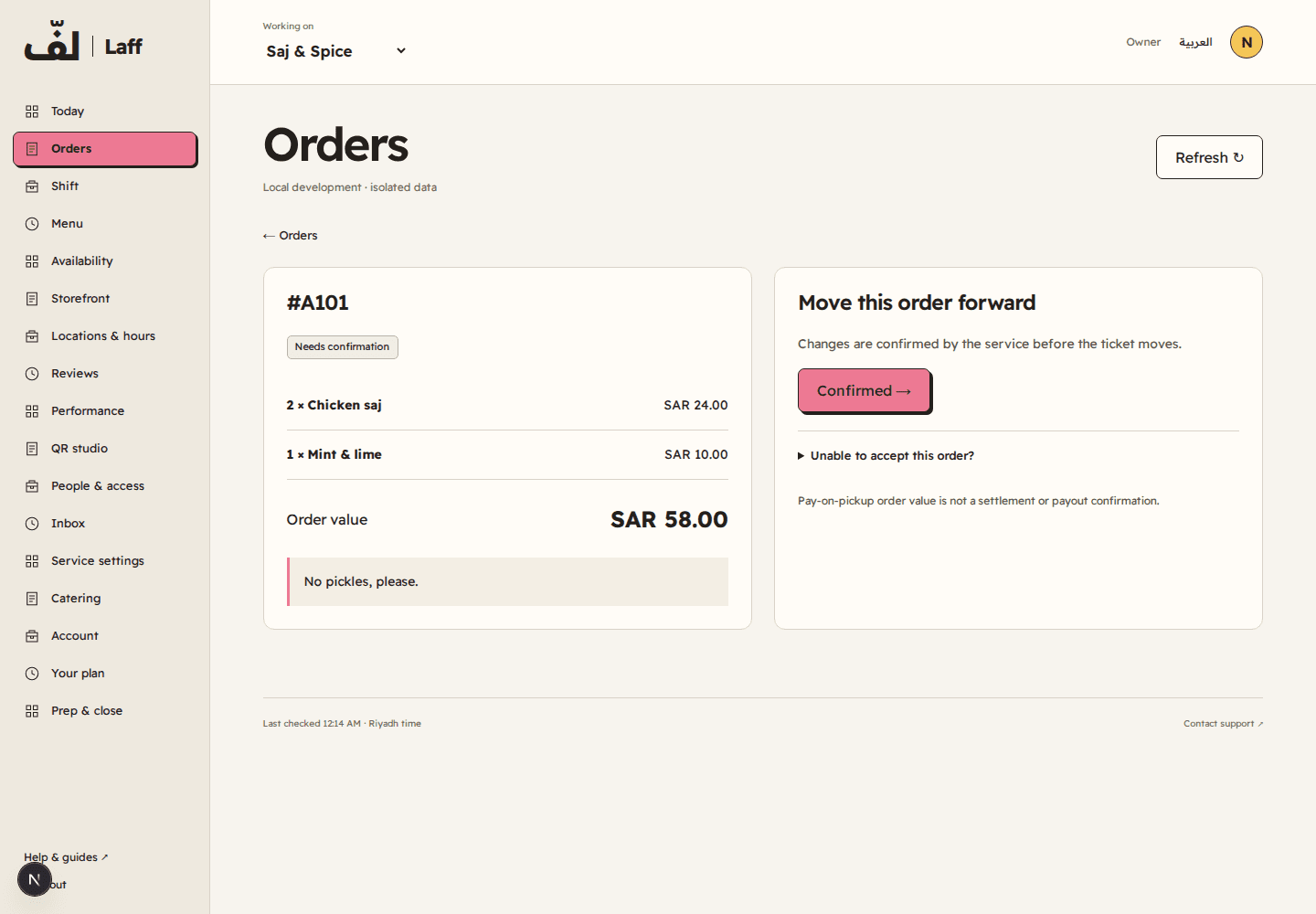
A new request is recorded. Its owner and required information are explicit.
Operational software should help someone understand what needs attention and take the next correct action. We map the task from intake to completion, including who can act, which information is required and how the result is confirmed. A dashboard full of charts is not a substitute for a workflow that people can finish.
Laff provides a concrete example: the customer's visit and the operator's shift are related but different experiences. The public interface needs a trustworthy state; the operator needs a calm way to change that state. Designing both around the same contract keeps visual polish connected to useful behavior.
We define which organization owns each record and which actions each role can perform. The backend enforces those boundaries; hiding a button in the interface is only presentation. Requests validate inputs, actions report a durable result, and errors distinguish an unavailable service from a permission the account does not have.
Integrations need equally explicit ownership. We determine which system is authoritative, how identifiers are mapped, and what happens to repeated or delayed updates. Existing systems are treated as constraints to understand. Replacing everything is not a prerequisite for making one important workflow reliable.
A request can be rejected, a downstream service can time out, or an operator can lose connectivity after submitting a change. The interface should preserve useful input, explain the current known state and avoid encouraging a blind duplicate. We design loading, empty, validation and recovery states as part of the feature.
The illustrative workflow on this page lets you inspect a request that needs review. It is not a disguised client screenshot or a claim about a deployed workflow. It makes the design question tangible: can a person tell what happened, who can resolve it and what changes after resolution?
Implementation includes behavior, permissions and the evidence needed to maintain it. We agree on meaningful acceptance journeys and verify critical failures. Handover covers configuration, deployment, data ownership and operational recovery appropriate to the scope. Support commitments are agreed explicitly rather than implied by a beautiful interface.
Start with the workflow causing the most friction: repeated manual entry, unclear status, permissions that depend on informal knowledge, or a process that fails between systems. A bounded first delivery can establish the contract and make the next part easier to build.
What was chosen, the alternatives, and the constraints behind it.
How normal work proceeds and where a person intervenes.
A bounded implementation or change plan agreed from the actual system.